The Future of HR Isn't Human vs. AI — It's Human and AI, Led by HR
I've been in enough boardrooms and break rooms to know when a profession is standing at a fork in the road. HR is standing at one right now, and how we handle the next few years is going to decide whether we're driving the bus or watching it pull away without us.
At SHRM26 in Orlando this June, SHRM President and CEO Johnny C. Taylor, Jr. said something that stopped me in my tracks. He told the crowd HR had "lost the plot" — that we got so focused on people that we forgot to ask the bigger question underneath it all. In his words: "We didn't quite keep up. We were so focused solely on people, and we sort of forgot where this is all going."
That bigger question is one every HR leader needs to sit with: what is the work, and who — or what — should be doing it?
From Labor Planning to Work Planning
For decades, HR's job was labor planning. How many people do we need. Where do we find them. How do we keep them. That was the whole game.
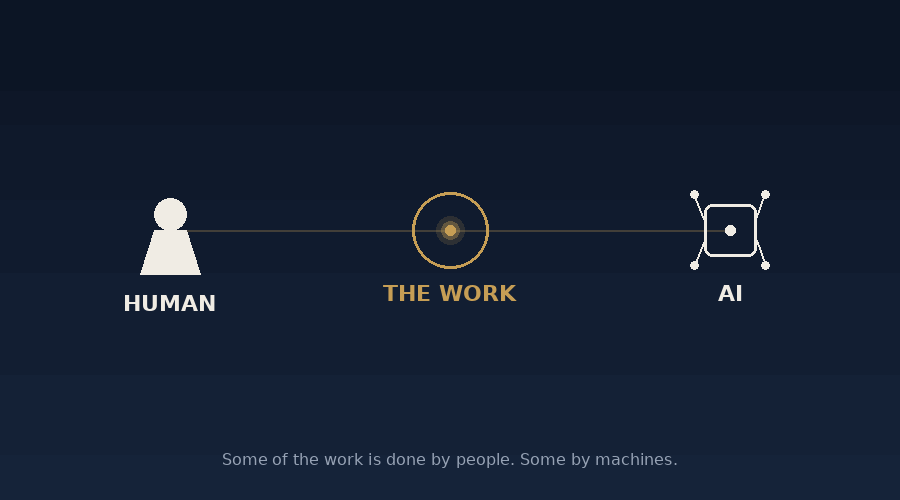
Taylor's message was that the game has changed. The new job isn't counting heads — it's designing work. Some of that work will still be done by people. Some of it will be done by machines. And figuring out which is which, deliberately and strategically, is now HR's responsibility. Taylor described the CHRO of the future as a "Chief Work Officer," someone who oversees the work that gets done by both people and technology, and who can forecast where the organization is headed the way a meteorologist reads a coming storm.
He put it plainly to the crowd: "There's nothing more revolutionary right now than the incursion of intelligent automation into the workplace." And he was just as plain about what leadership actually wants from us: "They don't care whether the answer to a work problem is a person, a platform, a partnership... They just want the work done, lowest cost, highest quality."
That's not a threat to HR. That's an invitation. Somebody in the organization has to be the one making that call — deciding which roles need a human being's judgment, empathy, and accountability, and which tasks are better handed to AI. Nobody is better positioned to make that call than HR. We know the work. We know the people. We know the business. The only question is whether we step up and claim that seat, or wait for finance and IT to claim it for us.
HR's Job Is to Lead AI In, Not Watch Jobs Walk Out
Here's where I'll plant my flag: AI is not coming for HR's job, or anyone else's, in the way the fear-mongering headlines suggest. AI is a tool. A powerful one, sure, but a tool all the same — and tools don't run organizations, people do. The real risk isn't that AI takes over. The real risk is that HR sits on the sidelines while everyone else decides how it gets used, without anyone asking the human questions: Is this fair? Is this sustainable? Does this actually make our people's work better, or just cheaper?
That's HR's job now. Not resisting AI, and not rubber-stamping it either — leading its adoption. Building the frameworks that decide where AI genuinely frees people up to do more meaningful work, and where a human being absolutely needs to stay in that seat. Training people to work alongside AI instead of fearing it. Making sure the "chief work officer" mindset Taylor described actually gets built into how organizations operate, not just talked about at a conference.
Done right, this is the moment HR stops being seen as a cost center and becomes what Taylor said every CEO actually wants: the function that gets the work done, at the right cost, with the right quality, by the right combination of people and technology.
I've Already Been Doing This Work
This isn't theoretical for me. I've helped organizations across professional services, SaaS, health and wellness, healthcare, non-profits, and real estate work through exactly this kind of transformation — figuring out where AI genuinely strengthens the business and where human judgment has to stay firmly in the driver's seat, and building the workforce strategy to match. I'm also currently working directly with OpenAI to help refine and train their models on HR, so I'm not just watching this shift from the outside — I'm helping shape how AI understands our profession from the inside.
If your organization is trying to figure out what the future of work looks like for your people — which roles need a human heart behind them and which processes are ready for AI — I'd love to help you map it out. I've done it across industries, and I know how to do it in a way that protects your people while positioning your business for what's coming.
Let's talk about what your workforce plan should look like for the next five years, not just the next five months.



Comments